fragments / fantasy
thoughts on self-disclosure and Tracey Emin's Second Life
In the aftermath of violence, the sense of smell becomes acute. On the tube and on the street, I smell men. Instead of turning me on, their sweat repulses me. It reminds me of the smell of school, teenage boys, their high-pitched laughs, their cruelty. Men are reduced to this in their worst moments and then it becomes impossible not to see and smell the boy inside every man.
In the car afterwards I kept touching that place below my lip, feeling the wetness. Nobody had made me bleed before. I almost admired it: look, you did something new. I was always the one to make myself bleed, as if to say I couldn’t be hurt by anyone because I could always do it better to myself, but I’d never scarred my own face.
By evening the bruise is the shape of Africa across my chin. I have nothing with me, just the clothes I’m wearing, no make-up, and I feel so embarrassed in the taxi to Notting Hill where two women scoop me up and start making phonecalls.
In the weeks that follow my hand moves to touch that spot as it heals and turns silver. Only half a centimetre but undeniable. Indignation and disbelief but also a touchstone against disbelief. After my lip healed last time I filed it away. I half-believed it was worth it. I could take it—and, besides, I was embarrassed at finding myself here again. I expected antibodies but I only had a familiar groove that gave no resistance. Shall we just pretend this never happened. Harder to do with the red on my fingertip. The first to bring what’s inside me to the outside surface.
I meet confusion when I try to explain how you can be scared of someone and want to speak to them at the same time but it seems obvious to me. The person who created the fear is also the one who can take it away by acting like they used to, like they’re safe. You reject the support of friends or professionals because they can only ease it slowly but the object of fear can disappear it all at once. It’s an evil deal because the big fear goes but instead you get a low-grade fear burning all the time and eventually it burns your whole interior out.
See him again and become an animal, soft and docile, feel the anger blink away, be willing, placid, even seductive. Deny reality. No longer see the face contorted in anger overlie the face in front of you, which is the face you love belonging to the body that made you feel protected when you laid your head against it. You want to let your head fall like that again, to be rescued by him from him. He sees none of the interior reasoning, just the limp and the neck.
Tracey Emin at the Tate Modern
I like the part of Tracey Emin: A Second Life at the Tate Modern where she’s tip-exed out the name of her rapist and then written it back in over the top.
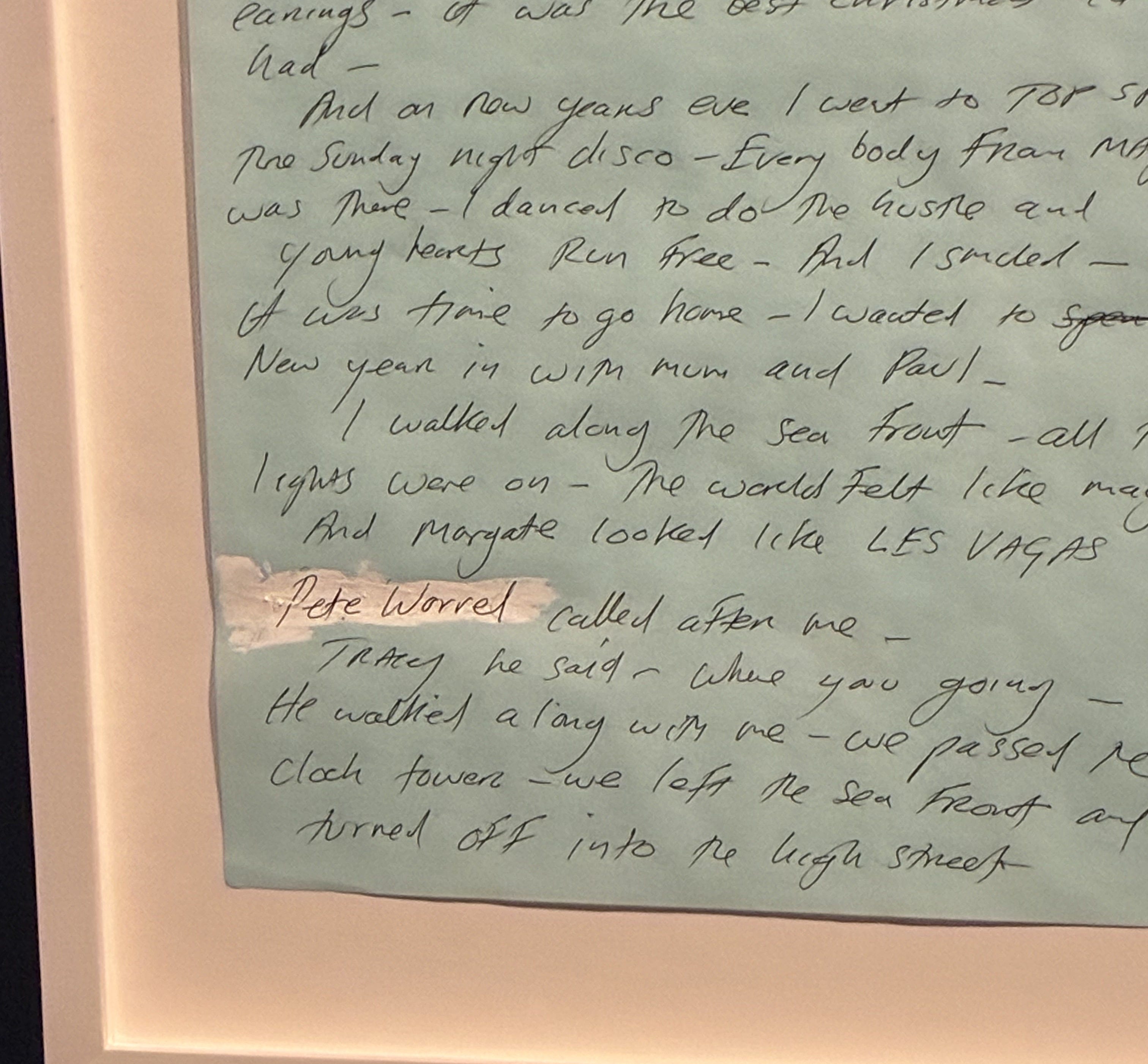
The exhibition makes me feel jealous. I wonder how she got away with it, making public things like this, because if you come from that background, you grow up with the knowledge that you won’t be protected or believed and that people will be able to get away with the things they do to you. Once you get the fame and wealth and institutional protection I guess you can say what you like. Maybe that’s when she wrote the name back in.
I liked the film Why I Never Became a Dancer (1995), which is projected onto a wall, especially the part where she says ‘the reason why these men wanted to fuck me, a girl of fourteen, was because they were less, less than human. They were pathetic.’ It still means a lot to see an artist who grew up that way, which leaves with you a persistent sense of dirt and roughness, not just talking about those things but turning them into art—she has so many imitators that it’s easy to forget why the original mattered. I haven’t really got to the place where I can do anything creatively with my upbringing because there’s so much shame there. I’ve always wished—and I remember being aware of this as a child as well—that I was given a home and an education that taught me how to behave like a respectable person or taught me anything about morality instead of having to learn it from first principles or untrustworthy figures of authority as an adult.
When I was younger I thought the way to deal with this was to become shameless, Emin’s approach, but I couldn’t stomach it because I had, somewhere and somehow, acquired a set of values that I wanted to live by but continually fell short of. Trouble always seemed to befall me at random without my having any power over it. My solution was to look for a source of external control, a man who was cold and hard enough to keep me in line. Remarkably, despite discovering religion, it never occurred to me to entrust my will and decisions to God rather than another human being.
Emin’s film How it Feels (1996) is at the centre of the Tate Modern exhibition. It’s about her botched abortion, how she felt about making the decision and the ‘emotional suicide’ that followed, where she destroyed her previous work after having her understanding of creation fundamentally altered. There’s a lot in there that’s valuable, a lot that usually goes unsaid—about regret, about killing, about having the nerve to escape poverty and being willing to maim your soul and murder a child you want to have so as not to go back there (I’m not editorialising.) What disturbed me was the lilting, infantile quality of her voice, which reminded me of my own, and the sense that all this art came at the expense of goodness. There’s the same quality in the work, the childlike scrawl of her writing in the paintings and the sweary, brightly coloured patchwork blankets. It’s as if she’s frozen at thirteen (a number I select because it’s the age at which she was raped) and the repeat revisitation keeps her stuck there. There’s some evidence that counselling can make depression worse by dwelling on negative events; EMDR seems to work, in part, because it brings the traumatic memory to mind only briefly without reimagining it in detail. Penance and Reconciliation is similar.
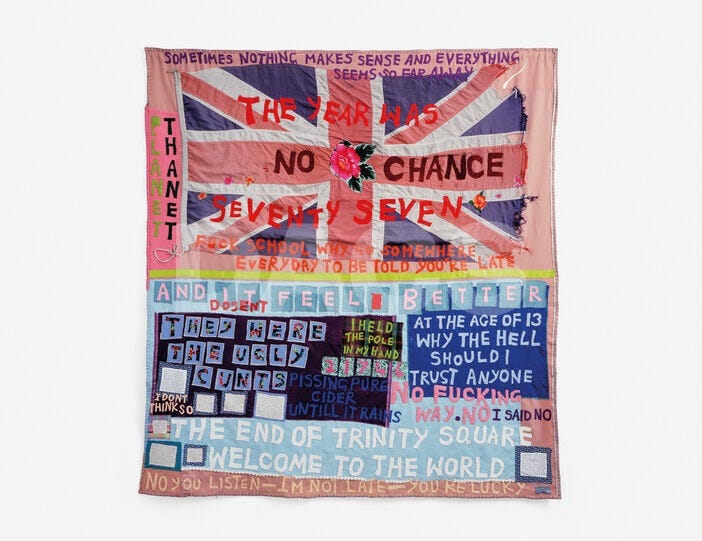
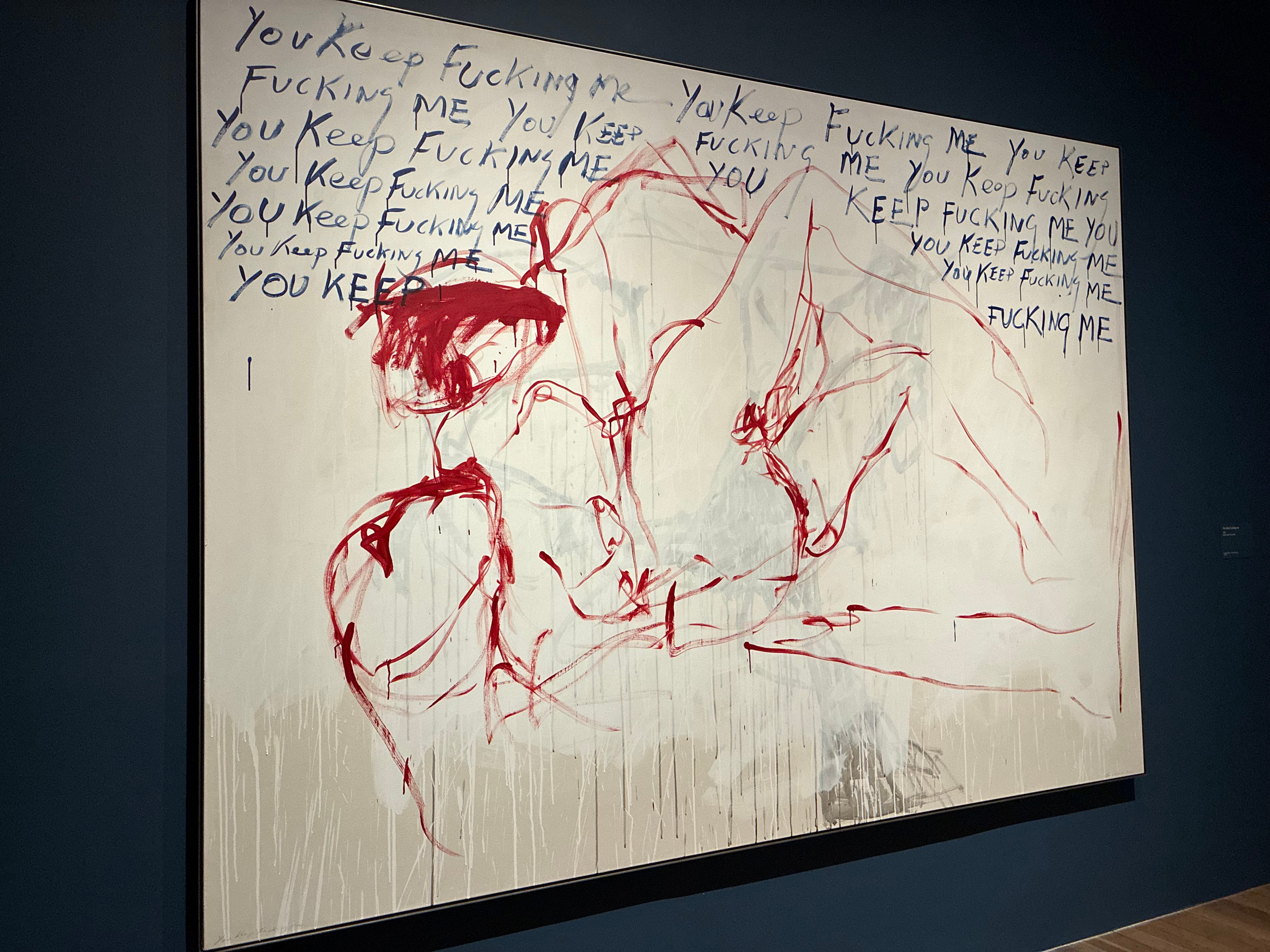
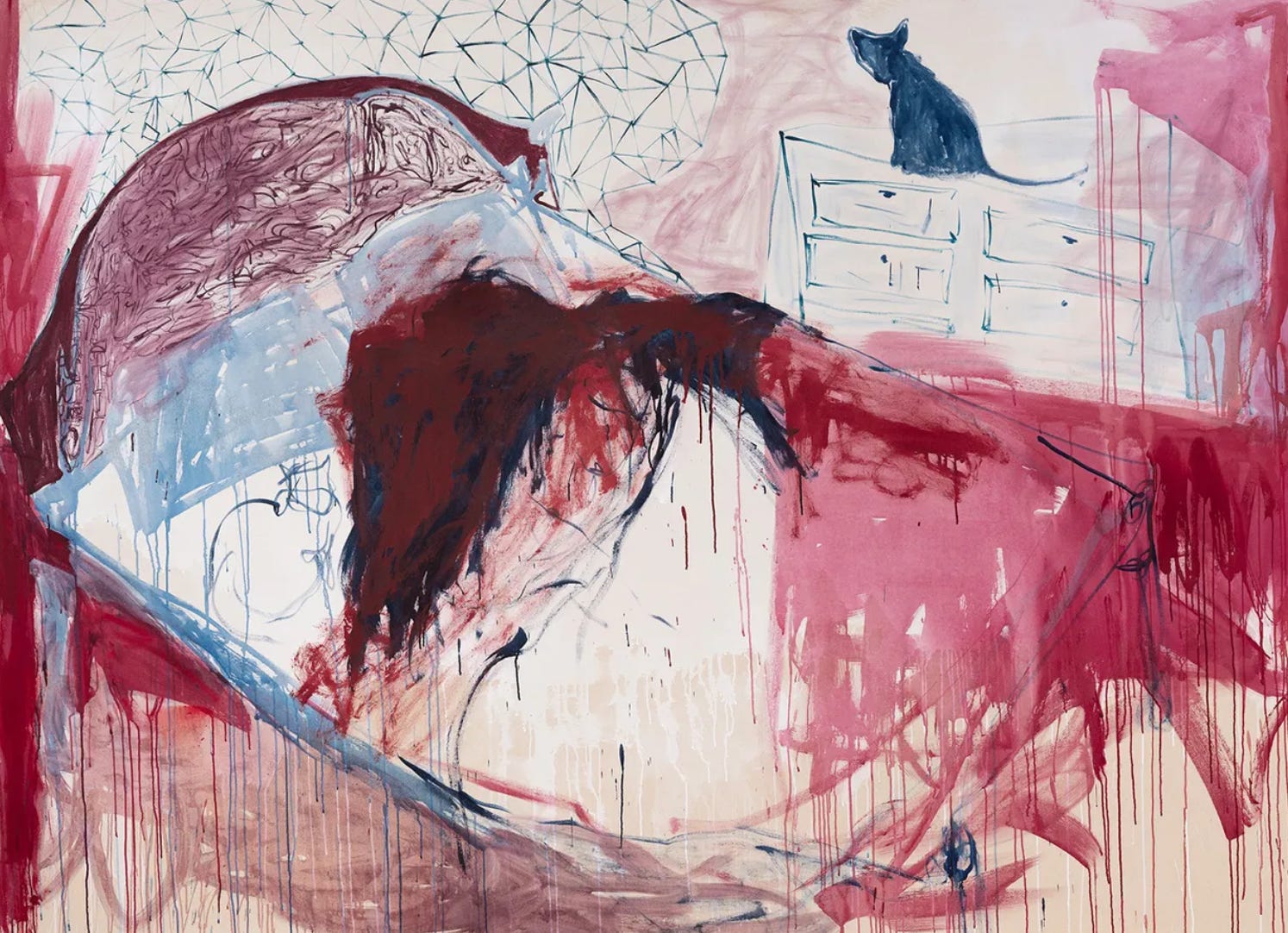
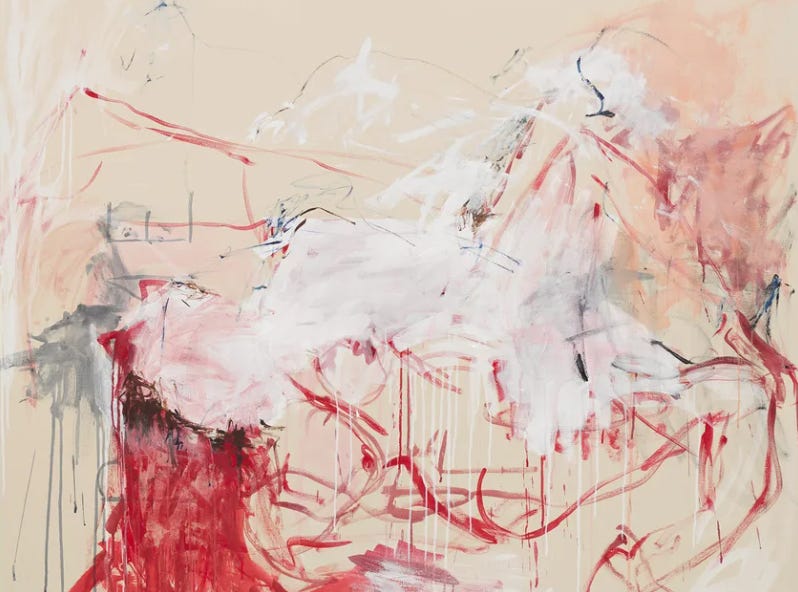
By the end of the exhibition I felt exhausted, sad and a bit sick. The relentless self-disclosure doesn’t seem to lead anywhere. The bronzes in the final room are beautiful and some of her newer paintings like The End of Love (2024) and Rape (2018) are among my favourite works but there’s nothing surprising in them. You couldn’t divide Emin’s career into periods (except perhaps before and after the abortion—you can see polaroids of her earlier, destroyed paintings at the beginning of the exhibition.) Her work is confession without catharsis or change. Her brutal personality alone has prevented her from becoming the joke at the centre of her work, which is what happens to most women who capitalise on their pain over and over again. Most can only get away with it once or twice. Emin gets away with it forever, which is her genius.